
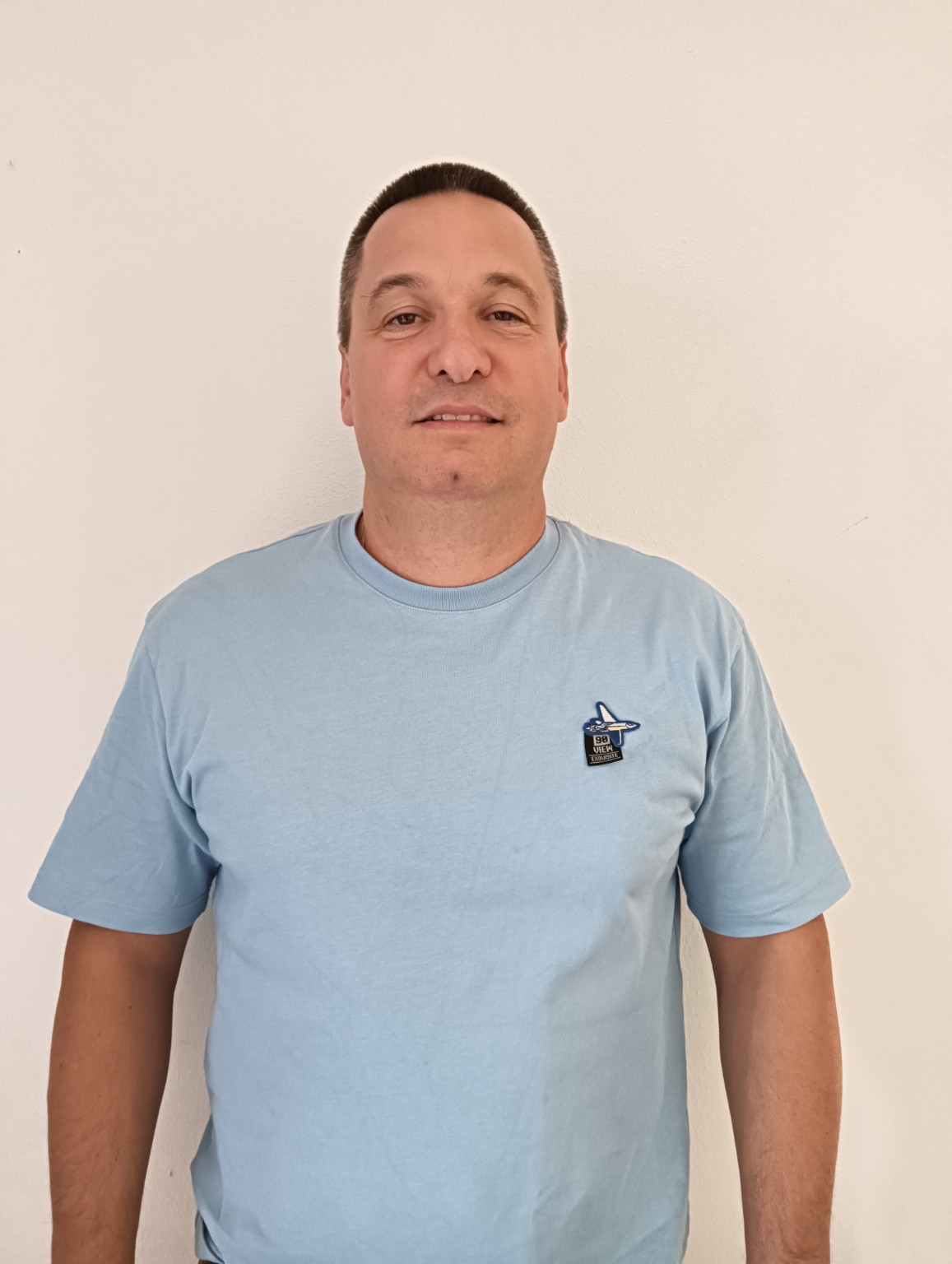
Biography / In his own words
From architecture to systematic market research.
Research first. Evidence before conviction.
- Born
- Argentina, 1977
- Education
- Architect, graduated 2001
- Research focus
- Systematic and quantitative markets
From Architecture to Quantitative Research
A personal journey from Argentina to Italy, from discretionary markets to systematic research, and from intuition to evidence.
Origins and education
I was born in Argentina in 1977. My professional path began far from financial markets. After completing primary and secondary education, including technical training as a Maestro Mayor de Obras, I went on to study Architecture in Rosario. I graduated as an architect in 2001.
My graduation coincided with one of the most difficult economic periods in Argentina's modern history. In the middle of that uncertainty, I decided to move to Italy and begin a new chapter of my life. That decision marked a major personal transition and, over time, also opened the door to a growing interest in financial markets.
The first encounter with markets
My first serious exposure to trading came through the foreign exchange market. Retail Forex at that time was a very different environment: many brokers operated from questionable offshore jurisdictions, aggressive marketing was common, and extremely high leverage was presented as a competitive advantage.
Leverage of 1:400 or even 1:500 was not unusual. The message was simple: more leverage meant more opportunity. In practice, I saw the opposite. Traders repeatedly lost entire accounts, often very quickly. The combination of excessive leverage, transaction costs, weak risk management, conflicts of interest and emotional decision-making made long-term profitability extraordinarily difficult.
The Question That Changed the Direction
The turning point was not a new indicator or a new market. It was a change in the way I thought about the problem.
If discretionary trading produces such inconsistent outcomes, can investment decisions be transformed into a systematic, measurable and testable process?
Searching for a better approach
Over the following years, I explored many different approaches to investing and trading. I studied value investing, swing trading, factor investing, options strategies, portfolio construction and systematic trading. Each discipline contributed something valuable to the way I now approach research.
Value investing reinforced the importance of economic reasoning. Factor investing introduced the idea that return patterns could be studied systematically across large groups of securities. Options highlighted the importance of volatility, probability and asymmetric payoff structures. But the decisive change came when I began studying the methods and long-term results of quantitative investment firms and systematic hedge funds.
What attracted me to quantitative research
What interested me most was not simply performance. It was the process behind it. Quantitative firms formulate hypotheses, collect data, test those hypotheses across large samples, measure risk, reject weak ideas and allocate capital to strategies that survive increasingly demanding levels of validation.
That philosophy was fundamentally different from the way I had first encountered financial markets. It replaced opinion with measurement, conviction with evidence, and isolated trades with repeatable processes.
The barrier for an independent researcher
For many years, serious quantitative research remained difficult for someone without a traditional programming background. Building a complete research framework could take months. Reliable historical data was expensive. Realistic backtests required knowledge of execution timing, transaction costs, survivorship bias, look-ahead bias and statistical validation. Moving a strategy from a notebook to a continuously running server created another layer of complexity.
The AI Inflection Point
Artificial intelligence did not make markets easy. It changed who can build the tools required to investigate them seriously.
A before-and-after moment
The arrival of modern artificial intelligence created a major change in what an independent researcher can realistically accomplish. Tasks that once required substantial programming resources can now be developed, reviewed and iterated dramatically faster.
Code can be prototyped in minutes. Large numbers of hypotheses can be evaluated systematically. Historical datasets can be processed in hours. Research frameworks can incorporate walk-forward testing, transaction-cost assumptions, Monte Carlo analysis, regime analysis and out-of-sample validation. Strategies can then be transferred from research environments to dedicated servers and monitored systematically rather than being dependent on a home computer.
The important limitation
Artificial intelligence does not automatically create profitable strategies. In fact, when experimentation becomes easier, the danger of overfitting becomes greater. If thousands of ideas can be generated quickly, statistical discipline becomes more important - not less.
Why implementation matters
A strategy is not complete when a backtest looks attractive. Implementation matters: execution timing, slippage, commissions, liquidity, data quality, infrastructure and operational reliability can all transform theoretical results into very different real-world outcomes.
This is why I consider dedicated infrastructure essential for systematic trading. The research process and the implementation process must be treated as two parts of the same discipline.
The central lesson
A profitable backtest is not evidence of a profitable strategy. It is only the beginning of the investigation.
Independent Research and Institutional Reality
The objective is not to pretend that an independent researcher has the same resources as a global hedge fund. The objective is to understand the differences and use them intelligently.
Where institutions have the advantage
Professional quantitative hedge funds have clear structural advantages. They can access superior datasets, specialized infrastructure, greater computing power and teams of researchers, mathematicians, programmers, traders and risk professionals operating across the world.
An independent researcher should never pretend those advantages do not exist. But large funds also face constraints that are very different from those of smaller capital bases.
Where independent research can be different
Large funds must deploy substantial amounts of capital. Liquidity and market impact become increasingly important. They must report continuously to investors, and extended periods of underperformance can lead to redemptions even when the underlying process remains sound.
Independent researchers operate with far smaller resources, but they may investigate strategies that are too small, too specialized or too capacity-constrained to be meaningful to a large institution. The opportunity is therefore not to imitate a multi-billion-dollar hedge fund, but to apply as much of the scientific discipline of professional quantitative research as realistically possible while preserving the flexibility of independent capital.
Institutional strengths
- Premium data and infrastructure
- Specialized teams
- Large-scale execution technology
- Deep operational resources
Independent flexibility
- Smaller capacity requirements
- Ability to investigate niche effects
- Longer patience with specialized research
- Fewer organizational layers
The Philosophy Behind Quant Research Desk
Quant Research Desk was created around a simple principle: markets should be investigated, not predicted.
Research before conviction
Every strategy begins as a hypothesis. That hypothesis must then survive data analysis, realistic execution assumptions, transaction costs, different market environments and multiple forms of out-of-sample testing. Promising results are treated as candidates, not conclusions.
Whenever possible, research includes realistic execution timing, walk-forward analysis, robustness testing, parameter sensitivity, higher-cost scenarios, drawdown analysis and tests specifically designed to discover whether an apparent market inefficiency is simply the result of overfitting.
Why negative results matter
Negative results are just as important as positive ones. If a hypothesis fails, that failure provides information. If an attractive backtest disappears after realistic transaction costs are introduced, that is information. If performance depends on one narrow parameter combination, that is information. And if a strategy performs exceptionally well historically but fails out-of-sample, the failure should be disclosed rather than hidden.
Hypothesis
Define what should exist and why before searching for the result.
Realistic execution
Respect signal timing, next-bar execution and implementation frictions.
Robustness
Challenge the result across parameters, dates, regimes and cost assumptions.
Out-of-sample evidence
Separate discovery from validation and preserve untouched data where possible.
Transparency
Report weaknesses, failures and limitations alongside strengths.
Why I Believe This Is an Extraordinary Time for Quant Research
Technology has democratized the tools. It has not eliminated the difficulty of finding genuine alpha.
A new research landscape
Access to computing power, financial data, cloud infrastructure and artificial intelligence has reduced barriers that existed only a few years ago. An individual researcher can now formulate an idea, build the research infrastructure, test it across hundreds of securities, challenge it statistically and deploy a systematic implementation with a level of sophistication that previously required a significant technical organization.
But easier access to tools does not make the central problem disappear. Finding a genuine, persistent and implementable market inefficiency remains difficult. That is precisely what makes the research valuable.
The purpose of Quant Research Desk
At Quant Research Desk, the objective is not to present trading as easy, and it is not to search for spectacular backtests. The objective is to investigate whether measurable market inefficiencies exist, understand why they might exist, determine whether they survive realistic implementation assumptions, and identify which ideas deserve further research and which should be rejected.
In quantitative investing, discovering that a strategy does not work can sometimes be almost as valuable as discovering one that does.
The objective of Quant Research Desk is not to prove that a strategy works. It is to make every reasonable attempt to prove that it does not - and to pay attention when it survives.